


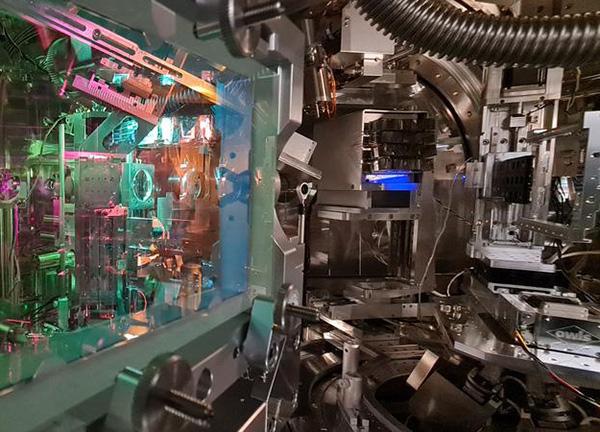
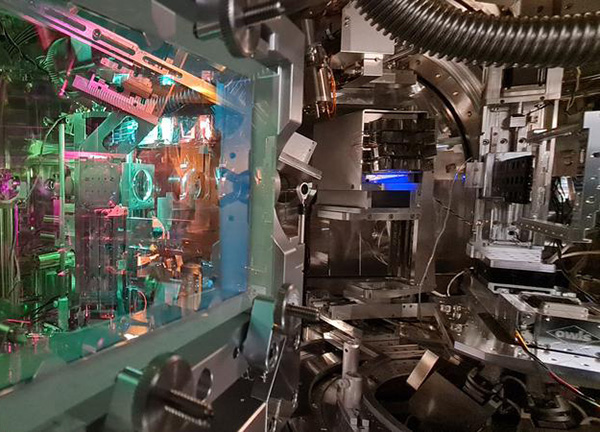
Fusion-relevant research is being conducted at the HED-HIBEF scientific instrument of European XFEL. DESY is part of the international HIBEF consortium. (Photo: European XFEL)
The way to the worldwide first commercial laser fusion power plant is perhaps long – but it will certainly go through the federal states Hamburg and Schleswig-Holstein in Germany. The Federal Ministry for Research, Technology and Space (BMFTR) has announced funding for three Fusion Hubs in Germany. One central part of the programme is the Laser Fusion Hub, which will be built with the international X-ray laser research centre European XFEL at its core. DESY is the main shareholder and works also closely with the European XFEL on the operation of its facility.
Laser fusion is one of several possible methods of achieving nuclear fusion, the process that powers the sun. Fusion is considered to be an energy-generation method of the future, wherein enormous amounts of electricity could be generated with relatively little waste. In addition to the Laser Fusion Hub, two further hubs are planned for ‘magnetic fusion’ and ‘fuel cycles and materials’. Germany is a major player in fusion research, with DESY among several associated research infrastructures that contribute to these efforts.
Taking part in the Laser Fusion Hub alongside European XFEL and DESY are the University of Hamburg (UHH) and Kiel University (CAU) as well as further partners. A decisive step is the inclusion of industry directly at the beginning of Fusion Hub programme. The companies Marvel Fusion and Focused Energy are shareholders and co-founders of the Fusion R&D campus and bring valuable perspectives with them. 'VEGA', the Laser Fusion hub on the Hamburg/Schleswig-Holstein campus, aims to bring together Germany’s existing expertise in photonics, optics, laser technology and the development of targets containing the fusion fuel.
For Moritz von der Linden, the CEO of Marvel Fusion, the initiative is an essential step on the way to industrially useful fusion energy. “Fusion energy will be the energy source of the 21st century – unlimited, safe and capable of providing baseload power,” he says. “With today's funding decision by the BMFTR, the Laser Fusion Hub becomes the place where we accelerate research using existing infrastructure and translate it into market-ready technologies: industry-led, open to the entire ecosystem and grounded in world-class science. This secures not only clean energy for tomorrow but high-tech jobs, supply chains and economic strength that will sustain Germany's prosperity for generations.”
Thomas Forner, CEO and Co-Founder, Focused Energy, says: “Affordable energy is the bottleneck of the 21st century. The availability of cheap, clean energy will determine where industry is built. For us, fusion is not a technology for short-term political cycles but for the long-term security of clean, safe and affordable energy. That is precisely why the hubs matter: They not only strengthen research and technology development but also create the industrial foundation for a new energy infrastructure.”
Thomas Feurer, Head of European XFEL says: “The European XFEL is one of the most powerful X-ray lasers in the world – our high-precision diagnostics for compression physics are unique globally. They are the key to experimentally validating concepts for laser fusion and making the right decisions as the technology develops.”
"Research groups from DESY and the University of Hamburg already bring important early work to the cooperation", says Franz Kärtner, lead scientist at DESY Photon Science and a professor for physics at the university. “DESY and UHH have developed an efficient high-energy and high-power cryogenic laser technology scalable to the stringent needs of future Laser Fusion power plants operable with various ignition schemes,” Kärtner says. “The Laser Fusion Hub is essential to perform this demanding scaling to unprecedented average power levels and high efficiency in close collaboration with industry.”
Initially, the hub will focus mainly on laser research but remains open to all actors within the ecosystem. DESY and the University of Hamburg are already poised to contribute their expertise in materials science—for example, in the search for optimal construction materials for reactor components capable of withstanding the extreme conditions of hot plasma.
Another site for the Laser Fusion Hub is being established in Biblis in the German federal state of Hesse. The BMFTR is funding these hubs through the “Hubs for Fusion” funding guideline which is part of the German government’s High-Tech Agenda.
(Partly from DESY and BMFTR News)
