


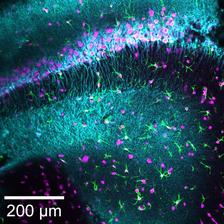
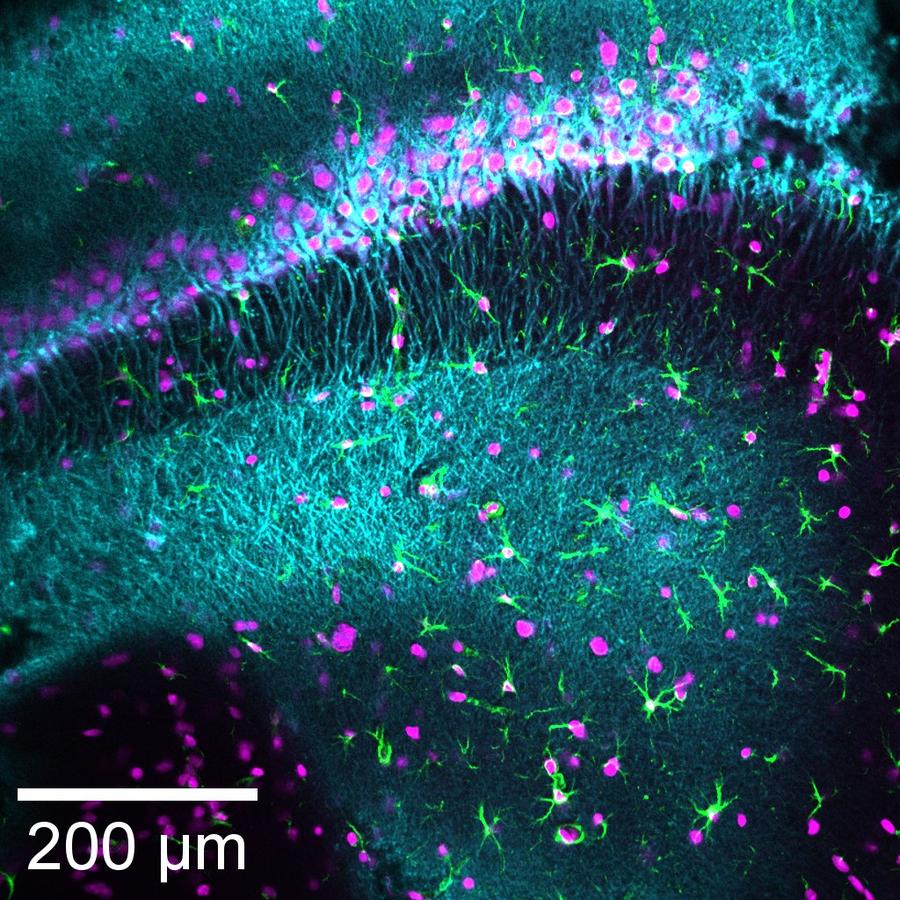
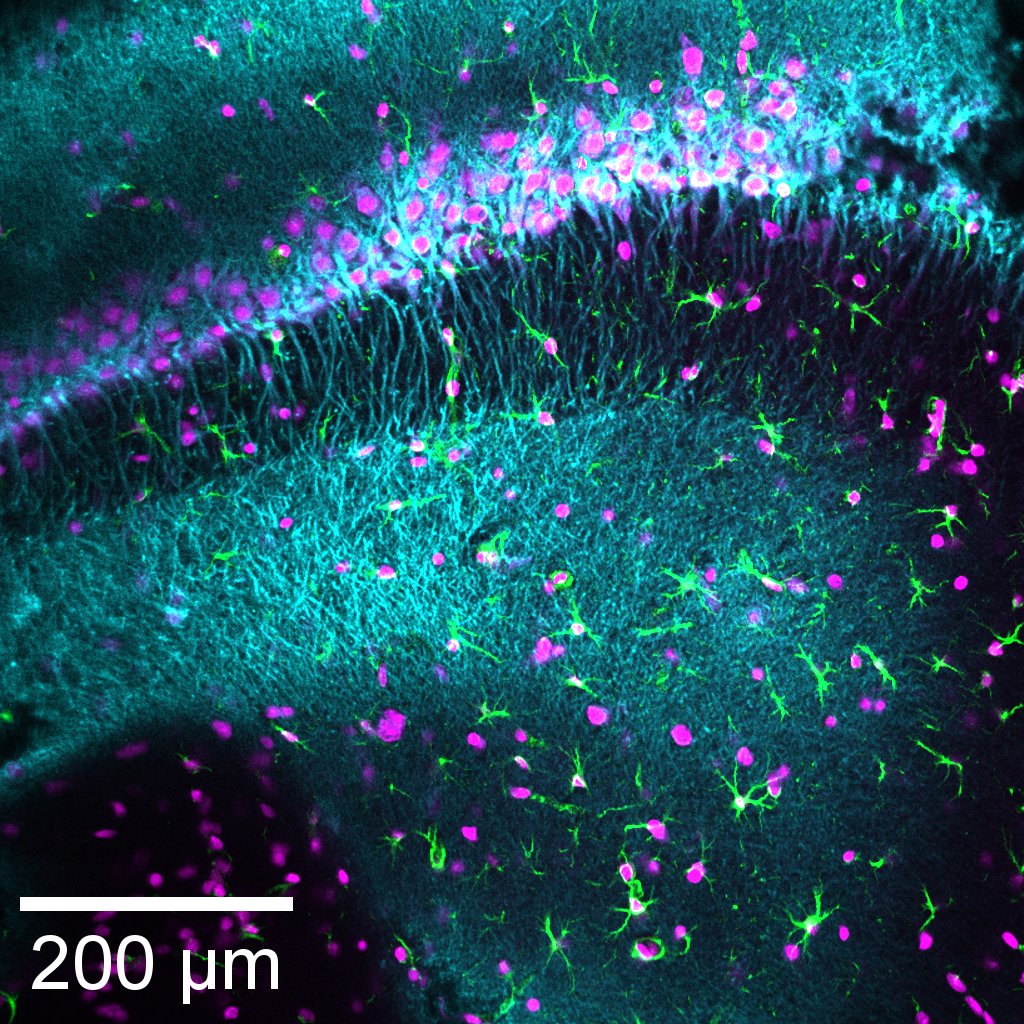
Detail from the figure below: densely packed neurons in triple-stained mouse brain tissue (see illustration below from: Marvin Edelmann/DESY).


Researchers at DESY, working with international partners, have developed a new laser system that could significantly simplify multicolour two-photon microscopy. The technology is based on a compact ultrafast fibre laser and makes it possible to visualise several cell types or structures at the same time, allowing complex interactions within tissues to be studied. The approach could also find applications in medical research. The team, led by researchers from the University Medical Centre Hamburg-Eppendorf (UKE) and DESY, reports its results in the journal Laser & Photonics Reviews.
Two-photon microscopy is an important tool in modern biomedical research. It enables high-resolution three-dimensional views of tissues and cellular structures. The technique becomes particularly powerful when several cellular components can be visualised simultaneously in different colours. In practice, however, this so-called multicolour two-photon microscopy is technically demanding, as it typically requires multiple expensive laser systems, each producing light of a different colour.
The study, led by DESY researcher Marvin Edelmann and UKE scientist Andreu Matamoros-Angles, presents an approach that significantly reduces this complexity. In the interdisciplinary project, laser physicists from the Center for Free-Electron Laser Science (CFEL) – a joint institution of DESY, the Max Planck Society, and University of Hamburg – worked together with researchers from the Institute of Neuropathology at UKE and the Universitat de Vic – Universitat Central de Catalunya (UVic-UCC), who contributed biological sample preparation and analyses. The collaboration reflects a broader effort at DESY to develop laser technologies in close partnership with other Hamburg-based research institutions.
Instead of combining several lasers, the system uses a single fibre-based ultrafast laser source. Using targeted simulations and a specially designed optical setup, the researchers were able to precisely tailor the broadband spectrum of the laser pulses, enabling the simultaneous generation of multiple, well-defined excitation colours from a single source to selectively target different biological structures and dynamics.
“The laser system is based on a single fibre laser whose spectrum is broadened using a specially designed photonic crystal fibre. The key advance is that we can use computer simulations to predict exactly which colours the fibre will generate. This makes the system reproducible and practical,” says Marvin Edelmann, first author of the study and a doctoral researcher at DESY and the Max Planck School of Photonics. “This work shows how targeted simulations can be used to develop a compact and cost-efficient short-pulse laser source for multicolour two-photon microscopy,” adds Mikhail Pergament, leader of the laser team in the Ultrafast Optics and X-rays (UFOX) group at DESY Photon Science.
The laser source generates three spectrally separated ultrashort pulses at around 960, 1080, and 1175 nanometres – wavelengths that are particularly well-suited for exciting commonly used fluorescent markers. To test the system, the researchers examined triple-labelled tissue samples from mouse brain, kidney, and liver. Using multicolour two-photon microscopy, different cellular structures could be visualised simultaneously, including neuronal networks, astrocytes, cell nuclei, blood vessels, and nerve fibres.
“Compact laser sources like this will make multicolour multiphoton microscopy much more widely accessible,” says Franz X. Kärtner, head of the UFOX group at DESY Photon Science and Professor of Physics at the University of Hamburg, where the study was performed. Markus Glatzel, Professor and Director of the Institute of Neuropathology at UKE, adds: “This technology will allow researchers to study complex biological processes involving multiple interacting cell types, for example in the brain or in tumour tissue. In the long term, it could help us better understand disease mechanisms and open new avenues for diagnosis and therapy. Such interdisciplinary approaches also open up new possibilities for time-resolved neuropathological investigations that critically depend on advances in laser technology.”
(Partly from DESY News)
Original publication
Marvin Edelmann, Andreu Matamoros-Angles, Mohsin Shafiq, Mikhail Pergament, Franz X. Kärtner and Markus Glatzel, Deterministic Fiber-Optic Spectral Engineering Enables Three-Color Multiplexed Two-Photon Microscopy, Laser & Photonics Reviews (2026) DOI: 10.1002/lpor.202502952
