


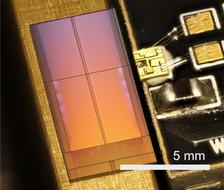


This microphotonic element is an important step on the way to a quantum internet. (Credit: Tobias Herr, DESY)
It may sound paradoxical, but light can actually be squeezed in order to use it for future quantum technologies. This usually calls for complicated laboratory equipment. However, a group from DESY Photon Science has now succeeded in creating a source of squeezed light on a component the size of a microchip. It is based on a tiny ring with a nanoscale structure that serves as a resonator. This development is an important contribution to the industrialisation of potential key technologies, such as a tap-proof quantum internet or superfast quantum computers.
Laser light can be manipulated in some unusual ways. For example, it can be squeezed – not literally, but figuratively, as a consequence of quantum physics. Like atoms and molecules, laser light obeys the rules of quantum mechanics. These include the uncertainty principle formulated by Werner Heisenberg. This principle states, among other things, that the amplitude and the phase of the light produced by a laser can never be accurately measured at the same time. Whereas the amplitude of a light beam is related to its brightness, its phase is a kind of time stamp that indicates how far the wave is in its oscillation cycle.
Laser light usually displays the same degree of quantum blurring in its amplitude and phase. However, sophisticated laboratory techniques can be used to reduce the uncertainty in one of the two variables, such as the phase. Squeezing the light in this way increases the achievable accuracy of measurements. Although this automatically increases the uncertainty in the other variable, in this case the amplitude, this fact is not relevant for applications which depend on the phase of the oscillation. Such states of light are already used in gravitational-wave detectors. Here they substantially increase the sensitivity of the measuring systems, which are several kilometres in diameter.
Up to now, however, the necessary states have mostly been generated using complex laboratory equipment mounted on large optical tables. The DESY Photon Science team led by Tobias Herr and Alexander Ulanov has now discovered a new and particularly simple way of generating squeezed light on a photonic, silicon-based chip – with a quality previously unattainable in such systems. At 7.8 decibels (dB), the squeezed light produced is close to the threshold of around 10 dB that is necessary for many quantum applications.
At the heart of the development is a microscopic light ring, known as a microresonator, with a diameter of just 150 micrometres. This corresponds roughly to the diameter of a human hair. Laser light is fed into this ring, which produces squeezed states using systematic non-linear effects. The trick is easily explained: “We have given the inner walls of the resonator a nanoscale corrugation pattern,” explains Ulanov. “This suppresses unwanted light processes which would otherwise compromise the squeezing of the light.” It is like listening to an orchestra and wanting to hear only certain notes while silencing other, undesirable ones.
Using simulations and a specially developed correction method to allow for manufacturing inaccuracies, the team was able to further optimise the structure. “DESY’s computing resources enabled us to carry out the complex simulations,” says Alexander Ulanov. “And we had access to the state-of-the-art laboratories on campus for our experiments.”
Unlike previous laboratory solutions, the chip was manufactured using a commercial semiconductor process – based on the same technology that is used to produce computer processors. “This is crucial for scalability,” explains Tobias Herr (DESY and Univ. Hamburg). “We are no longer talking about bespoke items made in a cleanroom, but about a technology that is suitable for mass production.” This was possible thanks to a trick: the design of the pattern was deliberately distorted so that the inevitable blurring during the manufacturing process would lead to the desired result.
The light states produced are key building blocks for various quantum applications: from quantum computers and the quantum internet to new measuring techniques with unprecedented precision. The low-loss silicon-nitride platform used can, in principle, be combined with other components, such as integrated lasers or detectors. “We see this not only as a breakthrough in research, but also as a real step towards practical applications,” says Tobias Herr. The team is already working on increasing the squeezing level to more than 10 dB – considered the threshold for many quantum computing protocols.
(Partly from DESY news)
Reference:
Alexander E. Ulanov, Bastian Ruhnke, Thibault Wildi and Tobias Herr, Quadrature squeezing in a nanophotonic microresonator, Nature Communications (2025) DOI: 10.1038/s41467-025-66703-x
