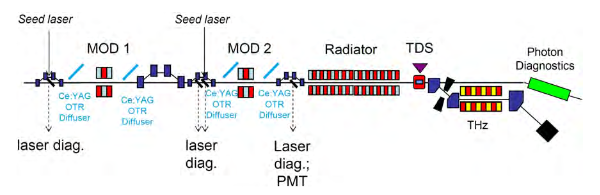
Schematic layout of a seeding section implementing EEHG seeding. From the first
modulator on, the quadrupoles (not shown) need to be on quadrupole movers for kick-free opera-
tion. (from 'FLASH2020+ Conceptual Design Report')
In the framework of the FLASH2020+ project, the FLASH1 beamline was upgraded to deliver seeded FEL pulses for users. In the seeding process, external conventional lasers are used to precisely tailor the longitudinal phase space of the electron beam before emission of X-rays. This produces stable, intense, nearly fully coherent pulses.
At FLASH, the seeding is achieved by combining high gain harmonic generation and echo-enabled harmonic generation with a wide-range wavelength–tunable seed laser, to efficiently cover the 4-60 nm wavelength range. The undulator chain was completely refurbished and features now six new radiators based on the APPLE- III design, allowing for polarization control of the generated light beams. With the superconducting linac of FLASH delivering electron beams at MHz repetition rate in burst mode, laser systems are being developed to seed at full repetition rates.
The new undulator chain of FLASH1 consists of two modulators and six radiator undulators. The former are planar devices with a long period of 84mm, while the latter are based on the APPLE- III design with 35mm period.
Further literature:
Rebernik Ribič, P., Abrami, A., Badano, L. et al. Coherent soft X-ray pulses from an echo-enabled harmonic generation free-electron laser. Nat. Photonics 13, 555–561 (2019).
E. Ferrari, S. Ackermann, M. Beye, I. Hartl, S. Hartwell, T. Lang, S. Mahmoodi, M. Mohammad Kazemi, P. Niknejadi, G. Paraskaki,
L. Schaper, S. Schreiber, M. Tischer, P. Vagin, J. Zemella, J. Zheng, "Status of the Seeding Upgrade for FLASH2020+ Project", in Proc. FEL2022, Trieste.