


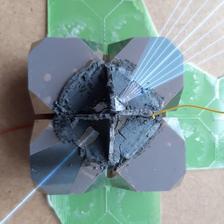


An example of a multi-anvil assembly with 4 anvils removed after a high-pressure and high-temperature experiment in Aster-15, the LVP at the PETRA III beamline P61B at DESY. As illustrated here, the incident beam (from the bottom left) and the diffracted X-rays would pass through the crushed gaskets (grey rock) between the tungsten carbide anvils (each anvil is 32 mm in size). The sample is embedded inside the pressure-transmitting medium (MgO) in the centre, where the press load is concentrated and thus high pressures are generated. (Credit: DESY)
A research team from the Bayerisches Geoinstitut (University of Bayreuth), DESY, and partner institutions in Japan and China, investigated how much water the mineral stishovite, a high-pressure form of quartz (SiO2), can incorporate deep inside the Earth at extreme pressures and temperatures. At PETRA III, the team led by Fei Wang and Tomoo Katsura (both from University of Bayreuth), measured the water solubility of aluminium-free stishovite at pressures of 33 to 38 gigapascals (GPa) and temperatures of 430 to 930 °C. These high pressures and temperatures (P-T) correspond to the pressures at depths of 900 to 1050 kilometers in Earth’s lower mantle. Using X-rays measurements carried out at the Large Volume Press (LVP) 'Aster-15' at the PETRA III beamline P61B, the researchers were able to demonstrate that water storage in stishovite under high pressure is very small at realistic deep-Earth temperatures. These results therefore indicate that aluminium-free stishovite is unlikely to be a major water-bearing mineral in the lower mantle under the conditions investigated. The findings were published in Geophysical Research Letters.
The Earth's deep-water cycle — the exchange of water between the surface and the mantle on a planetary-scale — plays an important role in how the Earth's internal structure was shaped in the course of a few billions of years. Water (H2O), incorporated in minerals, is known to be carried downward by subducting tectonic plates. However, since most water-bearing minerals in these plates break down before reaching the Earth’s lower mantle, the deep-water transport mechanism into the deep mantle has been poorly understood. An exception is the mineral is stishovite, which is highly refractory and stable even in the lower mantle. Stishovite is a high-pressure silica polymorph and comprises up to a fifth of subducted oceanic crust. Therefore, it was assumed that stishovite acts as a carrier for transporting water into the deep mantle. However, there are conflicting reports on its water storage capacity: some studies report the existence of super-hydrous stishovite, with a large water storage capacity, whereas other studies report very low water storage capacity in stishovite.
The study at the LVP at PETRA III could resolve this discrepancy by measuring the amount of water in stishovite under the P-T conditions typical for the Earth's lower mantle. Two materials were used: an anhydrous silica powder and a water-bearing silica gel. By using X-ray diffraction, the research team tracked the changes in the unit-cell volume of hydrous stishovite during compression, heating and step-wise quenching. From these X-ray data, the researchers deduced the excess volume of hydrous stishovite relative to dry stishovite to estimate the amount of incorporated water. Based on this a precise thermal equation of state for anhydrous stishovite was first determined, which gives its unit cell volume at any P-T. Then, they measured the unit cell volume of hydrous samples in the same high-pressure range where super-hydrous stishovite was reported. This approach helps determine whether the controversy surrounding the existence of super-hydrous stishovite arises from the different pressure ranges used in previous studies.
The research team could show that while super-hydrous stishovite (with ~3 wt.% H2O) exists at lower-mantle pressure of 38 GPa, but it only exists at unrealistic low temperatures below 430 °C. The water content drops steeply with increasing temperature becoming negligible, i.e. < 1000 ppm H2O above 730 °C. “Since subducting slabs are hotter than 730 °C at the bottom of the mantle transition zone,” says Fei Wang, the first author of this study. “These results show that pure stishovite cannot carry significant amounts of water into the lower mantle and is therefore unlikely to be a major reservoir either.”
Importantly, this study demonstrates that Aster-15, the LVP at the PETRA III beamline P61B, is able to resolve even subtle volume changes under extreme pressure conditions while accurately changing the high temperature. “The strength of this experiment was that we could observe stishovite directly at lower-mantle pressures while increasing the temperature step by step,” says Fei Wang. “This allowed us to track how water is released from the crystal under controlled high-pressure and high-temperature conditions.”
Original publication:
F. Wang, A. Chanyshev, L. Man, Y. Song, L. Wang, T. Ishii, N. Tsujino, S. Bhat, R. Farla, and T. Katsura, Limits of Water Storage in Stishovite at Deep Mantle Conditions, Geophysical Research Letters (2026), DOI: 10.1029/2025GL120078
