


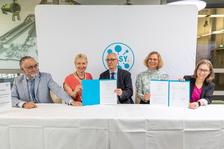


The signature ceremony of the MoU (from left): Michael Krisch (ESRF), Beate Heinemann (DESY), Jean Daillant (ESRF), Britta Redlich (DESY), Gema Martínez-Criado (ESRF). (Photo: DESY, Marta Mayer)
On the eve of the 86th meeting of the ESRF Council, hosted by DESY in Hamburg, The ESRF, the European synchrotron located in Grenoble (France) and DESY have signed a strategic Memorandum of Understanding (MoU) to strengthen their collaboration in the development of advanced software, data and computing technologies for photon science. Both operating world-leading high-energy synchrotron facilities, the two research centres are combining their complementary expertise to build a sustainable European software ecosystem that can support current and future generations of synchrotron and photon science facilities – a collaborative effort designed from the outset to welcome broader participation from research infrastructures across Europe.
At a time when scientific competitiveness increasingly depends on the ability to develop, deploy and maintain sophisticated software infrastructures, the ESRF and DESY are combining their expertise to advance shared solutions for beamline control, data acquisition, data analysis and scientific computing — with the ambition of creating the foundations for a community-driven European ecosystem that can evolve sustainably and respond to the growing needs of photon science.
DESY and the ESRF share a long-standing and productive partnership across multiple scientific and technological domains. This year, as the ESRF celebrates six years of successful operation of ESRF-EBS, the first of a new kind of fourth-generation high-energy synchrotrons, and as DESY progresses with the PETRA IV upgrade towards the brightest of synchrotron facilities, this new MoU reflects the strategic complementarity of the two research infrastructures. Together, they bring expertise spanning facility operation, instrumentation, software engineering, data management and scientific computing, creating a strong foundation for the development of common solutions for the benefit of the wider scientific community.
Shaping the future of scientific software for photon science
The complexity of today's scientific challenges, ranging from health and climate change to energy transition, advanced manufacturing and quantum technologies, requires increasingly sophisticated software capable of managing complex instrumentation, large-scale data streams and advanced computational workflows.
Through this MoU, DESY and the ESRF will deepen their collaboration in the development of software, data and computing capabilities that are becoming essential components of modern research infrastructures. By aligning their expertise and coordinating development efforts with other research centres across Europe, they aim to establish the critical mass needed to accelerate innovation and strengthen the long-term sustainability of key software platforms.
”The synergy between the ESRF and DESY is key to address the increasingly complex scientific and technological challenges of our time,” said the Director General of the ESRF. “By combining our complementary expertise and working alongside partners across Europe, we can create a sustainable software ecosystem that will support scientific excellence, accelerate innovation and strengthen Europe's ability to develop and maintain the technologies that are critical for scientific discovery and innovation.”
“Strong partnerships are essential for addressing the complex challenges facing modern science,“ said Britta Redlich, DESY Director for Photon Science. “Through our collaboration ESRF and DESY are creating a sustainable foundation for software and technology development that will enable scientific breakthroughs, foster innovation and strengthen Europe’s research ecosystem. Open to other facilities and partners, the collaboration demonstrates that Europe’s leading research infrastructures can achieve greater scientific and technological impact by working together than by acting alone.“
The shared ambition extends beyond the development of software itself. DESY and the ESRF seek to foster a European ecosystem in which research facilities can jointly develop, deploy, maintain and continuously improve common solutions. By promoting wider adoption, interoperability and shared ownership, they aim to reduce fragmentation, increase efficiency and ensure that strategic software capabilities remain sustainable and accessible to the scientific community in the long term.
The collaboration will focus on several strategic areas, including:
Beamline control systems, including the BLISS (BeamLine Instrumentation Support Software) software environment
Data acquisition, processing, analysis and curation infrastructures
Scientific computing and data management technologies
Joint software development activities, training and knowledge exchange
Strengthening Europe's scientific capacity through collaboration
As Europe develops two of the world's most advanced fourth-generation synchrotron facilities, ESRF-EBS and DESY´s PETRA IV, the collaboration between the ESRF and DESY demonstrates how complementary research infrastructures can achieve greater impact by working together. The agreement builds on a shared vision that strategic software capabilities should be developed collectively, sustained over the long term and made available for the benefit of the broader photon science community.
By creating the foundations for a common software ecosystem, the ESRF and DESY aim to foster a more integrated European research landscape through interoperable tools, shared expertise and more efficient services. In doing so, they seek to accelerate scientific discovery, support innovation and reinforce Europe’s ability to develop and sustain the digital technologies that are essential to world-leading research.
