


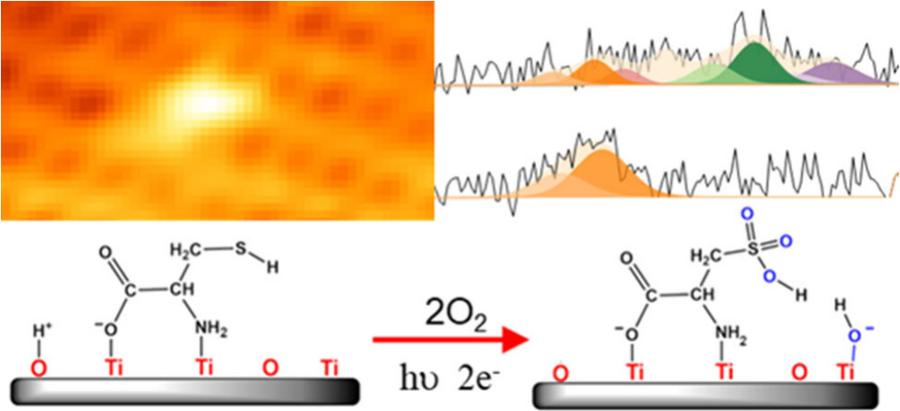
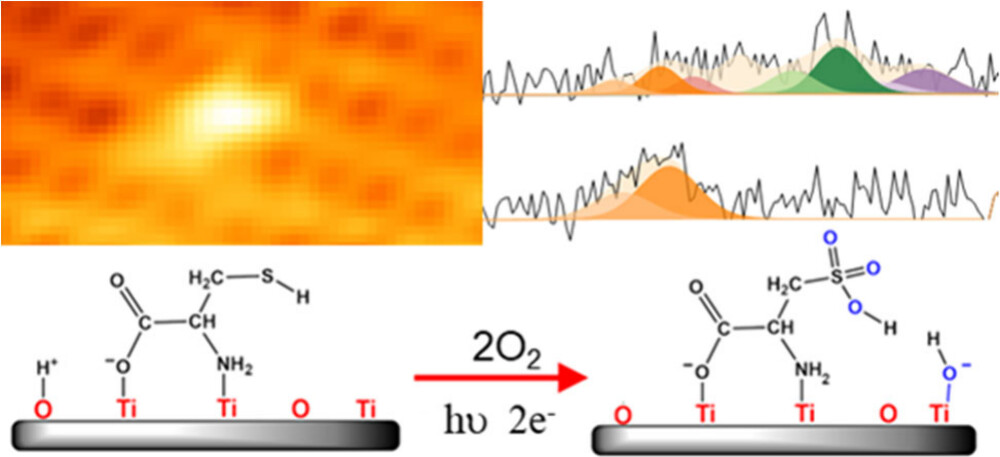
Light-driven oxidation of cysteine on anatase TiO₂. By combining high-resolution surface imaging, spectroscopy, and density functional theory (DFT) calculations, researchers uncovered how the thiol group is transformed into an oxidized sulfur species, providing molecular-level insight into fundamental photocatalytic processes. (Credit: DESY, Miguel Blanco Garcia)
Titanium dioxide (TiO₂) is one of the most extensively investigated photocatalytic materials, although many reaction pathways, like how relevant biomolecules interact with the surface, are not known in detail. Using a combination of Scanning Tunneling Microscopy (STM), X-ray photoelectron spectroscopy (XPS), Fourier transform infrared-reflection absorption spectroscopy (FT-IRRAS) and density functional theory (DFT) calculations, the study of an international team of researchers from Università di Milano Bicocca (Italy), Princeton University (US), University of Hamburg and DESY reveals why photocatalytic oxidation of cysteine occurs exclusively at the sulfur-containing thiol group while leaving other functional groups largely unaffected. Here, cysteine is used as biologically relevant model systems, as these amino acids possess a thiol group that is highly reactive. It plays a key role in redox processes, protein folding and biochemical signal transduction.
The study Led by Heshmat Noei at DESY NanoLab combined experimental work carried out by Miguel Blanco Garcia with computational data obtained in the group of Cristiana Di Valentin from Università di Milano Bicocca and Annabella Selloni from Princeton University. Their work shows that cysteine adsorbs on anatase TiO₂ through multiple stable configurations involving nitrogen, sulfur and carboxylate interactions with surface titanium sites. Anatase is one of the more active crystal structures of TiO2. These adsorption structures position the sulfur atom in a favourable environment for reaction with photoactivated oxygen species generated under UV illumination.
Upon exposure to UV light in air induces a pronounced transformation of sulfur species characterised by disappearance of thiol and S–Ti-related signals and the emergence of new features corresponding to progressively oxidised sulfur (S) states. Remarkably, no significant oxidation of the amino group is observed.
Under illumination of UV light, oxygen from air is activated on the TiO₂ surface through electron transfer, forming a highly reactive OOH intermediate with hydrogen. This hydroperoxo species acts as the key oxidant, promotes sulfur oxidation either through sequential hydroxyl and proton transfer or, more efficiently, via direct oxygen transfer that forms an S=O double bond. This latter pathway is energetically favoured, highlighting OOH as a powerful surface-bound oxidant rather than molecular oxygen (O2) itself.
As the oxidation proceeds, sulfur in cysteine is progressively converted from a thiol (-SH) to higher oxidation states of -S–OH and -S=O species. Interestingly, these intermediates show evidence of partial radical character with unpaired electrons localised on sulfur, indicating that the oxidation is electronically delocalised.
A second O₂ molecule is required to complete this process. It adsorbs on the Ti surface while a hydroxyl group is transferred to form a -SOOH intermediate. This step further increases the sulfur oxidation and ultimately yields sulfonic acid (-SO₃H), a fully oxidised product with a strong thermodynamic driving force, as confirmed by DFT calculations.
Beyond identifying the final oxidation product, the study provides a detailed atomistic description of the intermediate oxidation states and reaction pathway responsible for sulfur-selective photooxidation and shows that water-derived hydroxyl groups assist the reaction and enable complete oxidation to sulfonic acid.
These findings offer new insights into the photocatalytic transformation of biomolecules at semiconductor interfaces and highlight the unique ability of anatase TiO₂ to direct oxidation chemistry with remarkable functional-group selectivity. The findings open the door to exploring how other sulfur-containing molecules respond to light-activated TiO₂ and may help explain the material's effectiveness in antimicrobial applications.
Reference:
D. Perilli, C. Daldossi, A. Ugolotti, D. Silvan Dolling, A. Stierle, A. Selloni, C. Di Valentin, H. Noei, M. Blanco Garcia: Adsorption and Sulfur-Selective Photooxidation of Cysteine on Anatase TiO2(101), Journal of the American Chemical Society (JACS), 2026.
https://doi.org/10.1021/jacs.6c07370
