


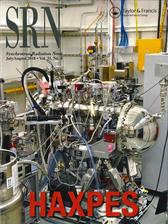


The POLARIS Instrument featuring on the cover of the Synchrotron Radiation News (July/August 2018, Vol31 No.4)
Important note:
The POLARIS experiment at beamline P22 is a collaboration with the group of Martin Beye at Stockholm University. Please get in touch well in advance with the beam line staff or the Beye group prior to proposal submission!
Summary
The endstation POLARIS (PhOtoeLectron AnalyseR for In-situ Spectroscopy) is designed for investigations of surface chemistry in the range of 0.2-0.5 bar and 100-500°C, with occasional measurements reaching 1 bar and 800°C. In particular, this setup combines the chemical and surface sensitivity of X-ray photoelectron spectroscopy to enable operando or in-situ studies of gas-solid interfaces with the most industrially relevant reaction conditions in the field to date. The main focus of the instrument is mechanistic studies of heterogeneous gas-solid catalytic reactions, while emerging fields include topotactic materials and hydrides.
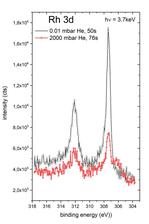

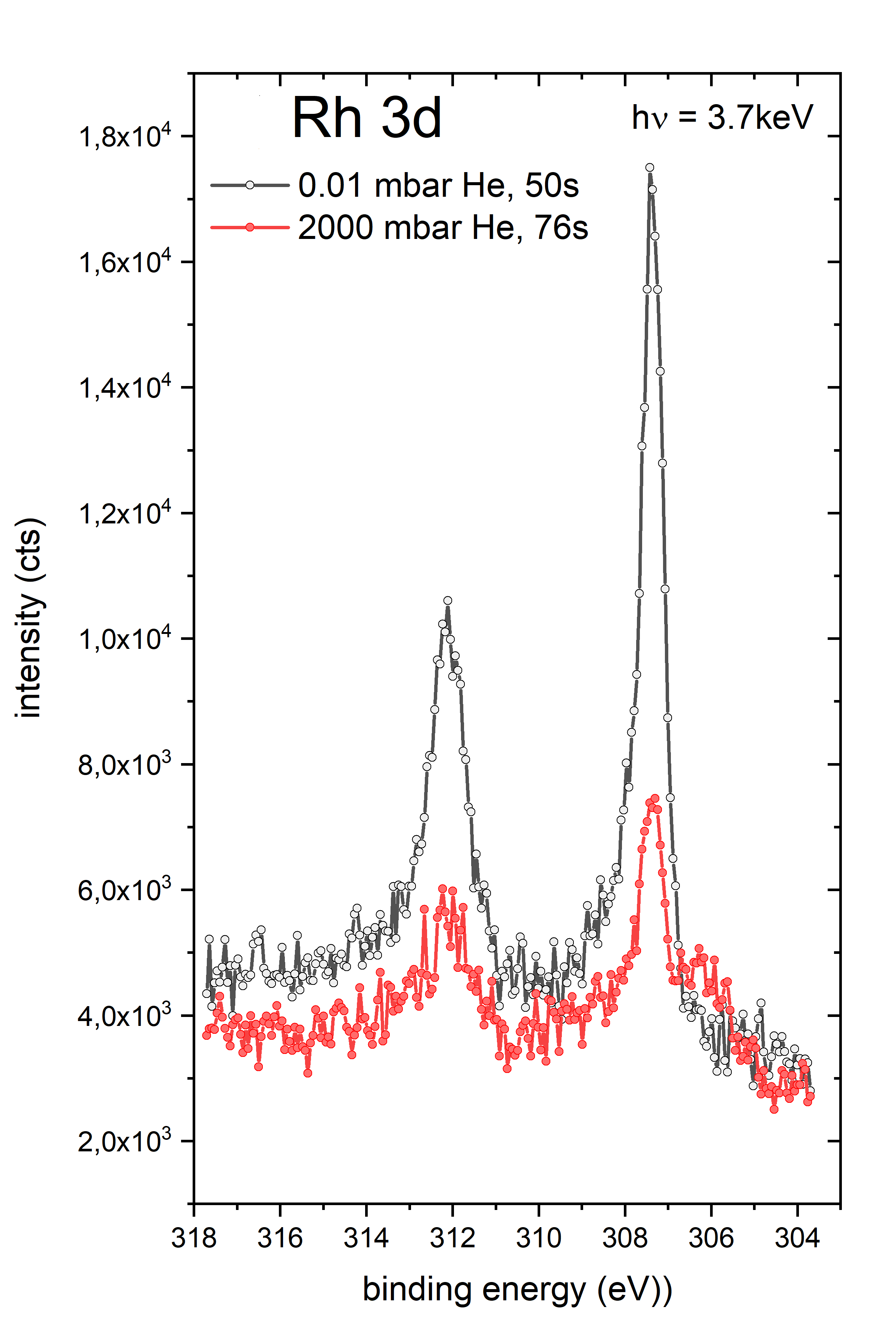
Example of Rh 3d spectra measured during the initial commissioning of the instrument in April 2018. Spectra were recorded at a Helium pressure of 0.01 and 2000 mbar. Please note the short acquisition times.
Instrument specifications:
The instrument is based on an R4000 electron analyzer and a HiPP-2 differentially pumped pre-lens system, both from Scienta Omicron. This setup creates a “virtual” pressure cell, pressurized only at the interaction point of the X-rays with the sample, and allows a minimal travel distance of the photoelectrons in the high-pressure regime. The analyzer inlet (the so-called “front cone”) was custom-made to allow for small apertures (Ø10-20 micrometers) effectively separating a high-pressure volume from the vacuum of the analyzer. In addition to the small apertures, the front cone also implements the gas inlets. Gas flows on the order of 0.2-10 l/min are dosed directly into the 30-60 micrometer space between the sample and the front cone. The chamber rests on a hexapod with micrometer and microradian precision in all 6 degrees of freedom. Measurements are performed in grazing-incidence geometry with typical angles ranging from 0.3° to 0.7° and resulting X-ray footprints on the sample of 10-20 µm in vertical and 800-1500 µm in horizontal direction. A base vacuum of 10-6 mbar is typically reached within 30 minutes after pumping the chamber. The chamber is equipped with an Ar+ sputter gun. Evaporators for alkali and other metals are available upon consultation. A mass spectrometer is available to probe residual gases from the first differential pumping stage.
Samples and gas environments:
At present, the following gases can be routinely used at POLARIS: inert gases (CO2, N2), noble gases (He, Ar), hydrocarbons (CH4, C2H4), NO, O2, CO and H2. Additional gases may be allowed after proper consultation. The sample holders are designed for hat-shaped single crystals with a 7 mm polished surface. Other types of samples, such as thin films or powders, may be accommodated using custom copper or stainless steel holders, which mimics the intended sample shape. Please consult before submitting proposals for thin films or powder samples. The samples are heated from the back with a boron nitride resistive button heater, and the temperature is controlled through a feedback system based on a thermocouple reading. A 5-axis sample manipulator allows for precision alignment of the sample with respect to the front cone.
History:
The instrument was built in 2014-2018 in Anders Nilsson’s group at Stockholm University, the design and construction led by Peter Amann (currently at TU Darmstadt). The instrument was specifically designed to probe the surface chemistry of hydrogenation reactions at elevated pressures, and was financed by a grant from the Swedish research council (Vetenskapsrådet). During 2017, the instrument was first shipped to DESY and to beamline P22, at the then newly built PETRA III east extension hall. The first spectra were acquired early 2018, (see figure) breaking the world record in the very niche sport of “high-pressure XPS”. The instrument was inherited in September 2023 by Martin Beye, at the time a newly appointed professor at Stockholm University. Successful experiments combining AP-HAXPES and structural techniques operando were first carried out at the end of 2025. The instrument is currently maintained in collaboration between beamline P22 and the Beye group at Stockholm University. As of February 2026, the instrument has produced ~30 peer-reviewed scientific publications, a selection of which is presented below.
Recent publications (updated 26th February 2026)
L. Bannenberg et al., "Influence of Hydrogen-Incorporation on the Bulk Electronic Structure and Chemical Bonding in Palladium", Adv. Sci. (2026) e22098.
R. Engel et al., "Mechanistic insights into methanol production on Ni5Ga3 thin films: An in situ XPS and DFT study", Appl. Catal. B: Environ. 381 (2026) 125798.
B. Davies et al., "Insight into the Carbon Monoxide Reduction Reaction on Cu(111) from Operando Electrochemical X-ray Photoelectron Spectroscopy", Angew. Chem. Int. Ed. 64 (2025) e202506402.
P. Lömker et al., "In-situ probing of the Fischer-Tropsch reaction on Co single crystals up to 1 bar", Nat. Comm. 16 (2025) 1005.
Highlight publications
C. Goodwin et al., "Operando probing of the surface chemistry during the Haber-Bosch process", Nature 625 (2024) 282.
P. Amann et al., 'The state of zinc in methanol synthesis over a Zn/ZnO/Cu(211) model catalyst', Science 376 (2022) 603.
S. Blomberg et al., "Bridging the pressure gap in CO oxidation", ACS Catal. 11 (2021) 9128.
Instrument publications (to be used for citing POLARIS)
P. Amann et al., 'A high-pressure x-ray photoelectron spectroscopy instrument for studies of industrially relevant catalytic reactions at pressures of several bars', Rev. Sci. Instrum. 90 (2019) 103102.
