


Fig. 1: Correlation schemes in coherent X-ray scattering experiments. Left: X-ray cross correlation analysis (XCCA). Right: X-ray photon correlation spectroscopy (XPCS).
In the research field “Complex Liquids” we study structure and dynamics of soft matter, in particular colloidal and aqueous systems. The main focus lies on coherent X-ray scattering experiments at modern synchrotron light and free-electron laser sources. These experiments are performed with custom-made sample systems synthesized in our group (see enabling technologies/lab infrastructure) and are accompanied by different characterization methods (UV-Vis spectroscopy, dynamic light scattering, transmission electron microscopy, …) as well as molecular dynamics, Brownian dynamics and Monte Carlo simulations.

Using coherent X-rays as probe, the instantaneous sample structure is encoded in the diffraction pattern, the so-called speckle pattern. Therefore, sample dynamics can be studied by means of X-ray photon correlation spectroscopy (XPCS), tracking changes of the speckle pattern over time. Spatial correlations in the framework of X-ray cross correlation analysis (XCCA) can provide access to higher-order structural information beyond simple pair-correlation functions. Within this research field we develop further and apply these methods for state-of-the-art experiments on liquids, glasses and soft matter systems in different projects outlined below.
Structure and dynamics in soft matter systems and nanocrystal superlattices
Despite intensive studies in the past decades, the local structure of disordered matter is widely unsolved. Scattering methods, typically used to study structure and dynamics on different length scales, allow access to ensemble averaged information only, e.g. the pair-correlation function g(r). Various phenomena in nature are dominated by changes in orientational order while g(r) remains almost unchanged. These structural changes are often accompanied by dynamical heterogeneity, i.e. different regions in the material show different relaxation behavior. In this project we perform XPCS and XCCA experiments to understand the connection of structure and dynamics in different soft matter systems, comprising (1) crystallization, gelation and glass transition in colloidal systems, (2) dynamical heterogeneities in soft core-shell systems, (3) dynamics in biological and complex media and (4) structure formation in colloidal self-assembly processes.
(1) Since colloidal particles can by synthesized in different sizes and shapes, they may show a rich phase diagram including a variety of crystalline and glassy phases. The phase of a colloidal dispersion can be chosen by tuning the interaction potential of the system and controlling the concentration of particles. This makes them excellent model systems to investigate crystallization and glass transition phenomena. We pay special attention on the connection of dynamics and higher-order structural correlations approaching the glass transition, a gel state or crystallization in different colloidal systems (including hard spheres, charge-stabilzed and varous core-shell systems).
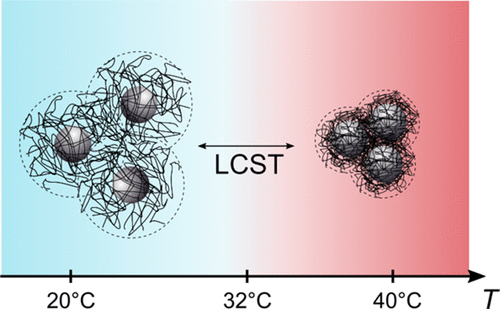
Fig. 2: Schematic Silica- PNIPAM core-shell particles undergoing the volume phase transition at the LCST of 32 °C. Taken from J. Phys. Chem. Lett. 10, 5231 (2019).
(2) In nature, heterogeneity is a frequently observed phenomenon. In particular, soft matter systems are dominated by dynamical heterogeneity, e.g. in glass transition processes discussed in (1). A prominent example showing heterogeneous dynamics over different length scales are polymers. Among those, Poly(N-isopropylacrylamide) (PNIPAM) is in the focus of research due to its reversible phase transition at the lower critical solution temperature, where it transforms from a swollen, hydrophilic state to a collapsed, hydrophobic one around 32 °C. We focus on silica core – PNIPAM shell systems, that are studied from dilute states by means of dynamic light scattering up to dense, crowded states where we apply XPCS to follow the sample dynamics in different swelling states.
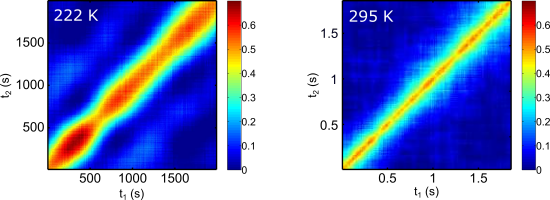
Fig. 3: Two-time correlations in a polymer (PPG4000) measured by XPCS. At lower temperature close to the glass transition of the polymer, oscillations along the diagonal t1=t2 are visible that reflect the heterogeneous nature of the sample dynamics. From H. Conrad et al. Phys. Rev. E 91, 042309 (2015).
(3) By exploiting the high degree of coherence at modern X-ray sources, our experiments focus on nanoscale fluctuations, diffusion processes, and structural reorganizations across microsecond to hour timescales, especially in complex, crowded, or viscous environments. XPCS provides unparalleled insight into the real-time behavior of bological media, that defines functionality in living and synthetic systems. This covers equilibrium dynamics of protein solutions as well as the dynamics of functionalized nanoparticles in biological enviroments relevant for drug delievery and therapy.
(4) The ability of colloidal nanocrystals to form ordered structures by self-assembly is an attractive way to obtain functional devices. However, due to limited understanding of intricate interactions between colloidal particles in a solvent-mediated assembly process, the materials based on nanocrystal assemblies are still far from their utilization. Therefore, detailed control and understanding of the self-organization of colloidal particles and their interactions in the course of drying is desirable. Here, we study (i) the in-situ assembly process by X-ray scattering and (ii) the structure of self-assembled films and clusters by means of XCCA to reveal the underlying mechanisms of self-assembly processes.
References
F. Dallari et al. Sci. Adv. 6, eaaz2982 (2020).
F. Lehmkühler et al. Sci. Adv. 6, eabc5916 (2020).
F. Schulz et al. Adv. Mater. Interf. 7, 2000919 (2020).
L. Frenzel et al. Phys. Rev. E 104, L012602 (2021).
F. Dallari et al. IUCrJ 8, 775 (2021).
A. Jain et al. J. Chem. Phys. 157, 184901 (2022).
N.N. Striker et al. J. Phys. Chem. Lett. 14, 4719 (2023).
F. Otto et al. Aggregate 5, e483 (2024).
N.N. Striker et al. J. Appl. Crystallogr. 58, 919 (2024).
F. Dallari et al. Sci. Adv. 10, eadm7876 (2024).
F. Schulz et al. Soft Matter 20, 3836 (2024).
A. Girelli et al. Nature Commun. 16, 10814 (2025).
N.N. Striker et al. Mater. Adv. 7, 5065 (2026).
W.D. Brackett et al. Phys. Rev. E 113, 061001 (2026).
C. K. Ofosu et al. Sci. Adv. 12, eaec4820 (2026).
Water and hydrogen bond systems
The structure and properties of liquid water is one of the most fascinating topics in natural science and has been discussed controversially for over one century. Supercooled water in particular has been proposed to show a variety of local structures ranging from clathrate-like clusters to mixtures of high and low density structures in the framework of the two liquids hypothesis. However, experimental studies were not able to prove such models so far. With the advent of hard X-ray FEL sources it is possible for the first time to take snapshots of the instantaneous structure of water using ultrashort coherent X-ray pulses. In this way both spatial correlations via XCCA and dynamics via XPCS become accessible.
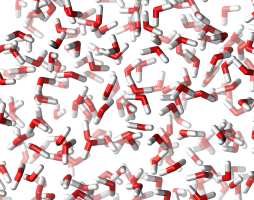
Fig. 4. Molecular Dynamics simulation snapshot of liquid water.
Within this project we aim to facilitate coherent X-ray scattering experiments on liquid water at ambient and supercooled conditions, in nanoconfinement, as well as structure and dynamics studies of amorphous and crystalline ices. Taylor-made sample environments, including a liquid jet sample environment, are used in (coherent) X-ray scattering experiments at FEL and storage ring facilities.
References
F. Perakis et al. Nat. Commun. 9, 1917 (2018).
F. Lehmkühler et al. PNAS 117, 24110 (2020).
F. Lehmkühler et al. Phys. Unserer Zeit 52, 298 (2021).
M. Ladd-Parada et al. Environ. Sci.: Atmos. 2, 1314 (2022).
H. Lee et al. J. Phys. Chem. Lett 14, 10999 (2023).
N. C. Gießelmann et al. J. Phys. Chem. C 128, 499 (2024).
N. C. Gießelmann et al. J. Chem. Phys. 161, 034508 (2024).
A. Karina et al. Commun. Chem. 8, 82 (2025).
C. Goy et al. J. Chem. Phys. 163, 110401 (2025).
A. Gierke et al. J. Phys.: Conf. Ser. 3010, 012151 (2025).
R.P.C.Bauer et al. J. Phys.: Conf. Ser. 3010, 012156 (2025).
Y.-H. Lee et al. Nature Materials 25, 302 (2026).
T. Eklund et al. J. Chem. Phys. 164, 014501 (2026).
J. Giebelmann et al. J. Chem. Phys. 164, 174504 (2026).
Correlation methods at modern X-ray sources
With the advent of hard X-ray free-electron laser sources, coherent X-ray pulses with durations in the femtosecond regime became available for accessing structure and dynamics at unprecedented length and time scales. The higher average flux and superior degree of coherence allow to access larger wave vector transfers q and short timescales down to femtoseconds. Furthermore, improvements in detector technology and the development of diffraction-limited storage rings will allow access to sample dynamics down to micro- and nanoseconds. Likewise, the detection of speckle patterns with such short exposure times enables the detection of higher-order correlation functions at unprecedented time scales with molecular and atomic resolution.
In this project we develop coherent x-ray scattering at new X-ray sources. Special attention is paid on the demonstration and application of XPCS and XCCA to study structure and dynamics of different types of samples. These experiments are accompanied by different computational and simulation approaches.
References
F. Lehmkühler et al. PNAS 117, 24110 (2020).
F. Lehmkühler et al. Appl. Sci. 11, 6179 (2021).
F. Schulz et al. Part. Part. Sys. Charact. 38, 2100087 (2021).
J. Möller et al. Phys. Rev. Lett. 132, 206102 (2024).
J. Möller et al. IUCrJ 12, 462 (2025).
F. Lehmkühler et al. Nano Trends 11, 100132 (2025).
C. Goy et al. J. Phys.: Conf. Ser. 3010, 012173 (2025).
A. Leonau et al. J. Synchrotron Rad. 33, 725 (2026).
T. Eklund et al. Photon Science 1, 174 (2026).
W. D. Brackett et al. Phys. Rev. E 113, 061001 (2026).
