


Measurement of protein diffusion across different length and time scales. (a) Representation of the molecular dynamics of ferritin proteins. The figures show short-term diffusion (top), the influence of cage effects (middle) and long-term diffusion (bottom). (b) Schematic representation of the megahertz X-ray photon correlation spectroscopy (MHz-XPCS) experiment. Incident X-ray pulses are scattered by ferritin protein solutions contained in a capillary, and the scattering images are recorded by a detector.
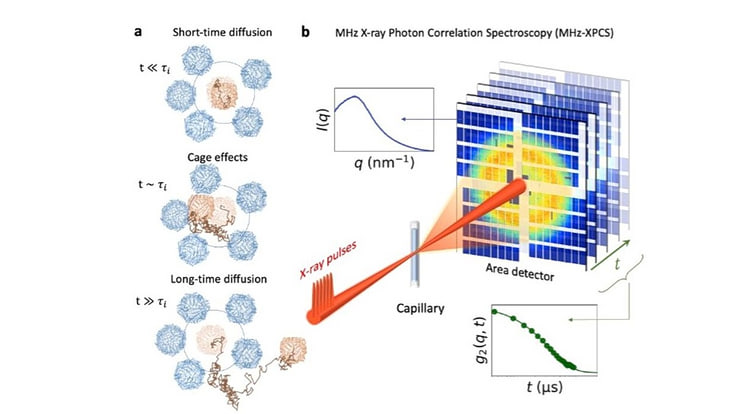
Understanding protein motion within the cell is crucial for predicting reaction rates and macromolecular transport in the cytoplasm. A key question is how crowded environments affect protein dynamics through hydrodynamic and direct interactions at molecular length scales. Using megahertz X-ray Photon Correlation Spectroscopy (MHz-XPCS) at the European X-ray Free Electron Laser (EuXFEL), we investigate ferritin diffusion at microsecond time scales. Our results reveal anomalous diffusion, indicated by the non-exponential decay of the intensity autocorrelation function g2(q, t) at high concentrations. This behavior is consistent with the presence of cage-trapping between the short- and long-time protein diffusion regimes. Modeling with the δγ-theory of hydrodynamically interacting colloidal spheres successfully reproduces the experimental data by including a scaling factor linked to the protein direct interactions. These findings offer insights into the complex molecular motion in crowded protein solutions, with potential applications for optimizing ferritin-based drug delivery, where protein diffusion is the rate-limiting step.
Nature Communications 16, 10814 (2025)
See also European XFEL news.
