


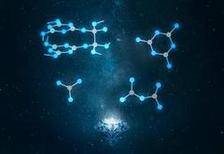
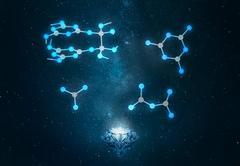
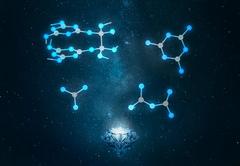
Using diamond anvil cells and laser heating, the research team has been able to produce new kinds of chemical reactions with ultra-stable carbon and nitrogen atoms, allowing them to form novel compounds with metals such as bismuth, cadmium, calcium and europium. (Illustration: Goethe University Frankfurt)
When it comes to the chemical elements, few are simultaneously as ubiquitous and necessary as carbon and nitrogen. They form the backbone of life, they enable many catalytic processes used in industry, they lie at the heart of many key materials in our everyday lives, and they make up over 78% of the composition of our atmosphere (almost all of that amount being nitrogen). Their chemistry has been widely studied for centuries, forming the foundation of organic chemistry and revealing entire libraries’ worth of reactions across inorganic chemistry. That chemistry forms the basis for common methods in mining, electroplating, pharmacology, and much more. But an international research team led by scientists at the Goethe University Frankfurt have shown that this familiar picture only accounts for a small fraction of what carbon and nitrogen can do—one just has to turn up the heat and the pressure. A series of studies published in the Journal of the American Chemical Society (JACS) and Angewandte Chemie International Edition reveal that under high pressure, carbon and nitrogen can simultaneously react with a variety of metals. The results could have a strong influence on future functional materials.
Carbon and nitrogen form very stable compounds. Molecular nitrogen N2 in the atmosphere, in particular, forms triple bonds that require a large amount of energy to break, and solid elemental carbon can be arranged to make diamonds, among the hardest and most corrosion-resistant compounds known. While carbon and nitrogen do react at ambient pressure forming cyanogen (CN)2 – a colorless toxic gas — their behaviour can completely change under high pressure.
However, the studies ley by scientists from the Goethe University Frankfurt revealed new pathways to make novel carbon-nitrogen anions through the use of extreme pressures. By pressing the reacting substances between two diamonds—in a device called a diamond anvil cell—while simultaneously heating the reactants at high precision using lasers, the team could get the nitrogen and carbon to bond together forming negatively charged ions which are stabilised in novel compounds with positively-charged metallic ions.
“These experiments were once known as ‘cook and look’,” says Nico Giordano, a DESY beamline scientist at PETRA III’s P02.2 Extreme Conditions experiment station and coauthor. “You would heat materials under extreme pressure to see what emerges, not quite knowing what to expect. The difference is now that the research team is able to anticipate the chemistry and deliberately access specific carbon–nitrogen compounds.” The scientists have come up with predictions and calculations on how the various reactants would react under these extreme pressure and temperature. These conditions are similar to the ones found in the interior of the Earth or other planets. The research team was able to work out how certain chemical changes or reactions could be achieved before the experiment, allowing for targeted design of new molecules. The team used P02.2 at PETRA III as well as beamlines at the European Synchrotron Radiation Facility (ESRF) in France to verify the production of the compounds as well as their reaction pathways. As carbon and nitrogen are also common in other planets than Earth, these reactions are interesting to planetary scientists in general, as they tell details of what chemical behaviour is like at certain depths within planets.
The reactions are of particular interest for designing new functional materials. Carbon and nitrogen compounds produced through this method could contribute to organic electronic components or new catalysts. “The significance of this discovery extends far beyond the identification of a few new compounds,” says Maxim Bykov, a professor of chemistry at the Goethe University Frankfurt and the principal investigator on these experiments. “It reshapes fundamental chemistry by showing that even for well-studied elements such as carbon and nitrogen, entirely new structural principles can remain hidden until the right conditions are applied.”
(from DESY News)
References:
Brüning L et al. "High-Pressure Synthesis of Crystalline Double-Layer Carbon Nitride Networks Stabilized in Bi7C10N18(N3(1-x)O3x)", Angewandte Chemie, 2025, DOI:10.1002/anie.202506406
Jurzick PL et al. "Stabilization of Fully Deprotonated Melaminate Anions (C3N6)6– in M3(C3N6) (M = Cd, Ca)", Journal of the American Chemical Society, 2026, DOI:10.1021/jacs.5c16752
Akbar FI et al., "Stabilization of the [C2N5]7– Anion in Recoverable High-Pressure Eu4Fe0.864(6)(C2N5)2 Pyronitridocarbonate", Journal of the American Chemical Society, 2026, DOI: 10.1021/jacs.5c21756
