


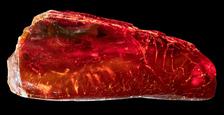


The piece of amber from Goethe's collection that was analysed at PETRA III, with the ant on the left. (Photo: University of Jena)


DESY’s light sources have illuminated quite a lot over the years – from viruses to space rocks to masterworks from Rembrandt and van Gogh. Now there’s another piece of science and cultural history to add to our collection of exotic samples: a piece of amber from the personal collection of German writer and polymath Johann Wolfgang von Goethe, within which a 40-million-year-old ant is trapped.
This news has attracted a lot of attention this week – at the PETRA III beamline P05, which is operated by the fellow Helmholtz research centre Hereon, researchers from the University of Jena took a closer look at a piece of amber from Goethe’s collection. The biologists wanted to know more about the 40-million-year-old insect trapped inside. This is because the ant, which is hardly visible with the naked eye, is long extinct. With the help of the X-rays from PETRA, the researchers could not only find out more about the external and internal structures of the ant, but also develop a 3D model that enables other scientists to make comparisons with future finds of the same species. This particular species of ant is very similar to a modern species native to North America that builds its nests in trees – which also explains why it ended up in amber, which is fossilised tree sap.
The fact that the research team brought Goethe’s amber to PETRA III is everything but a coincidence. Since more than a decade, the Hereon beamline has made studying amber one of its specialties and can analyse and make 3D pictures of objects contained within with the help of computer-assisted synchrotron microtomography. In Goethe’s amber collection, the team also found a gnat and a blackfly, and the ant is by far not the first encountered at the beamlines. "We’ve already discovered a fossil ant three and a half years ago, which was then named after the research centres Hereon and DESY: †Desyopone hereon,” explains Jörg Hammel, a Hereon scientist at the Institute of Materials Physics, who coordinated and led the work at the PETRA III beamline. “But the Goethe ant is the best preserved of its kind.”
The team behind the PETRA III beamline P05 have turned it into the central location for amber research in Europe. For Hammel, the fascination is as big as it was on the first day: “You can just travel back in time with a piece of amber. It’s a snapshot from the environment from millions of years ago. You see all the things that are trapped that tell you something about the ecosystem there.”
The P05 beamline and its technology are especially good at finding transitions between different kinds of materials. The tomography methods are so exact that they can elucidate details between two very similar materials. That is not only important for finding things caught in amber – it also has applications in medicine. “Different tissues have very faint changes in their densities, and we can still get amazing contrast with this same technique,” says Hammel. That enables very precise 3D pictures of complex structures comprising various kinds of tissue – and the better the understanding of such structures, the higher the chances are for effective development of treatments of disrupted or diseased tissues. The planned PETRA IV light source at DESY would improve the technique even further since the contrast would be even greater thanks to the better X-ray properties.
Bernhard Bock, one of the University of Jena scientists and a biologist at the Jena Phyletic Museum, is thrilled with the results. “We don't want to grind away or disturb such cultural assets – that's why DESY's methods at PETRA are so great,” he says. “We were able to obtain different perspectives, especially of the ant's head and chest area, and were surprised by the internal structures we found there – insights that this special technology makes possible.”
The Hereon researchers are also working on an EU project with a special goal: a worldwide digital amber catalogue in which exactly such finds and their 3D models can be openly accessible for all online. Often, amber fossils carry traces of other fossil organisms such as plant species or even reveal the complete internal anatomy of an organism. This catalogue would help many branches of science that examine changes in climate, ecosystems and biodiversity as well as helping further evolutionary and phylogenetic research.
This would’ve interested Goethe as well. We know Johann Wolfgang von Goethe (1749–1832) best as a writer and the author of such works as Faust. Exactly like his famous character Faust, Goethe was a major polymath in his time. Alongside geology, biology and botany, optics interested him greatly. His interest in amber lay in its optical possibilities, such as for fashioning lenses out of the fossilised sap. “Goethe was super interested in everything,” Hammel says. “One of the core terms in biology, ‘morphology’, was introduced to the scientific community by Goethe himself.”
(partly from DESY News (Univ. Jena News))
Reference:
Boudinout et al. "Discovery of Goethe’s amber ant: its phylogenetic and evolutionary implications", Scienctific Advances (2026), DOI: 10.1038/s41598-026-36004-4
