


Responsible: Dr. Mona Kohantorabi, FS-NL
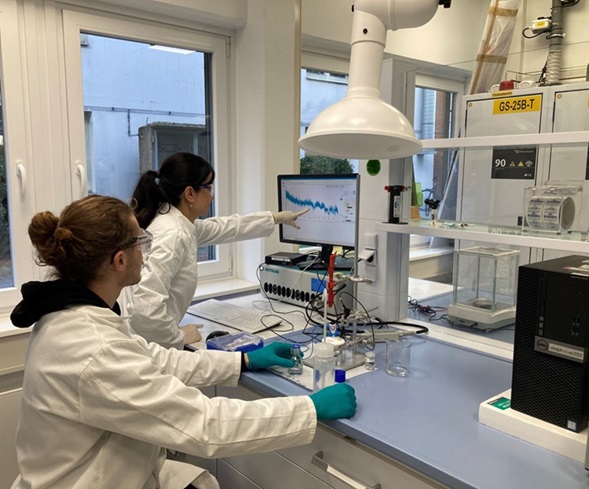
The electrocatalysis and electrochemistry laboratory of the DESY NanoLab is designed to support research on electrochemical and electrocatalytic systems at PETRA III and is equipped for both beamtime preparation and standalone experiments. The laboratory includes sample preparation facilities employing flame-annealing technique. In addition, a Langmuir trough operated by CAU Kiel is available for thin-film growth.
Electrochemical infrared reflection–absorption spectroscopy (EC-IRRAS) is available as an in situ, surface-sensitive technique to investigate solid–liquid interfaces under catalytic and electrocatalytic conditions. Reaction products can also be analyzed in the laboratory using high-performance liquid chromatography (HPLC). Inductively coupled Plasma-Mass Spectroscopy (ICP-MS) is also available in the lab and is suitable for ultra-trace elemental analysis in liquid samples.
Instrumentation
Standard chemistry laboratory equipment
- Two fume hoods
- Ultrapure water system
- Hot plates
- pH meter
- Analytical balance
- Oven
- Individual exhausts at workspaces
- Gases: Ar, H₂, N₂, CO₂
- Basic chemicals
- Glassware and standard laboratory equipment
Electrochemistry setups
- Autolab PGSTAT302N with FRA32M impedance module
- Autolab PGSTAT204 compact potentiostat
- Cables and connectors for various electrode configurations
- Electrochemical cells compatible with multiple beamlines
EC-IRRAS
- Fourier-transform infrared (FTIR) spectrometer with evacuated optics (Bruker Vertex 80v), equipped with a liquid-nitrogen-cooled mercury cadmium telluride (MCT) detector, suitable for conventional EC-IRRAS and polarization modulation (PM) EC-IRRAS
- In situ measurements during electrocatalytic reactions
- Identification of surface adsorbates, monitoring of reaction intermediates, and investigation of interfacial phenomena
- Compatible with single-crystal surfaces, well-defined model catalysts, and powder catalysts
- Gamry Reference 600+
- Potentiostat for electrochemical control during IR measurements
- Designed for fast, low-current measurements
- Maximum applied potential: ±11 V
- Electrochemical impedance spectroscopy (EIS): 10 μHz – 5 MHz
- A combined high-energy surface X-ray diffraction (HE-SXRD) and EC-IRRAS setup is available for simultaneous structural and chemical characterization of solid–liquid interfaces
HPLC
- Shimadzu SCL-40 system
- Refractive index detector (RID)
- Automated sample preparation (e.g., dilution)
- Quantitative analysis of reaction products in organic and aqueous phases
ICP-MS
- NexION 1100 Single Analyzer Quadrupole ICP-MS (Perkin Elmer)
- Autosampler
- Three gas channels to feed reaction gases.
- Operation mode: He only for collision mode, a helium-hydrogen mix for both collision and reaction modes, or operation in pure reaction gases.
- Continuous operation.
- Dual-stage discrete dynode detector.
- Supports syringe-pump-based auto-dilution systems.
- Spray chamber: Baffle-type glass cyclonic high sensitivity spray chamber with all matrix solution gas port.
- Dynamic Range of ion detection: 10 orders of magnitude, and 14 orders of magnitude with extended dynamic range.
- Mass range: 1 - 285 amu
- Typical operating resolution 0.7 amu, custom resolution to < 0.3 amu
| Contact |
|
Dr. Mona Kohantorabi +49 (0)40 8998 6020 |
