


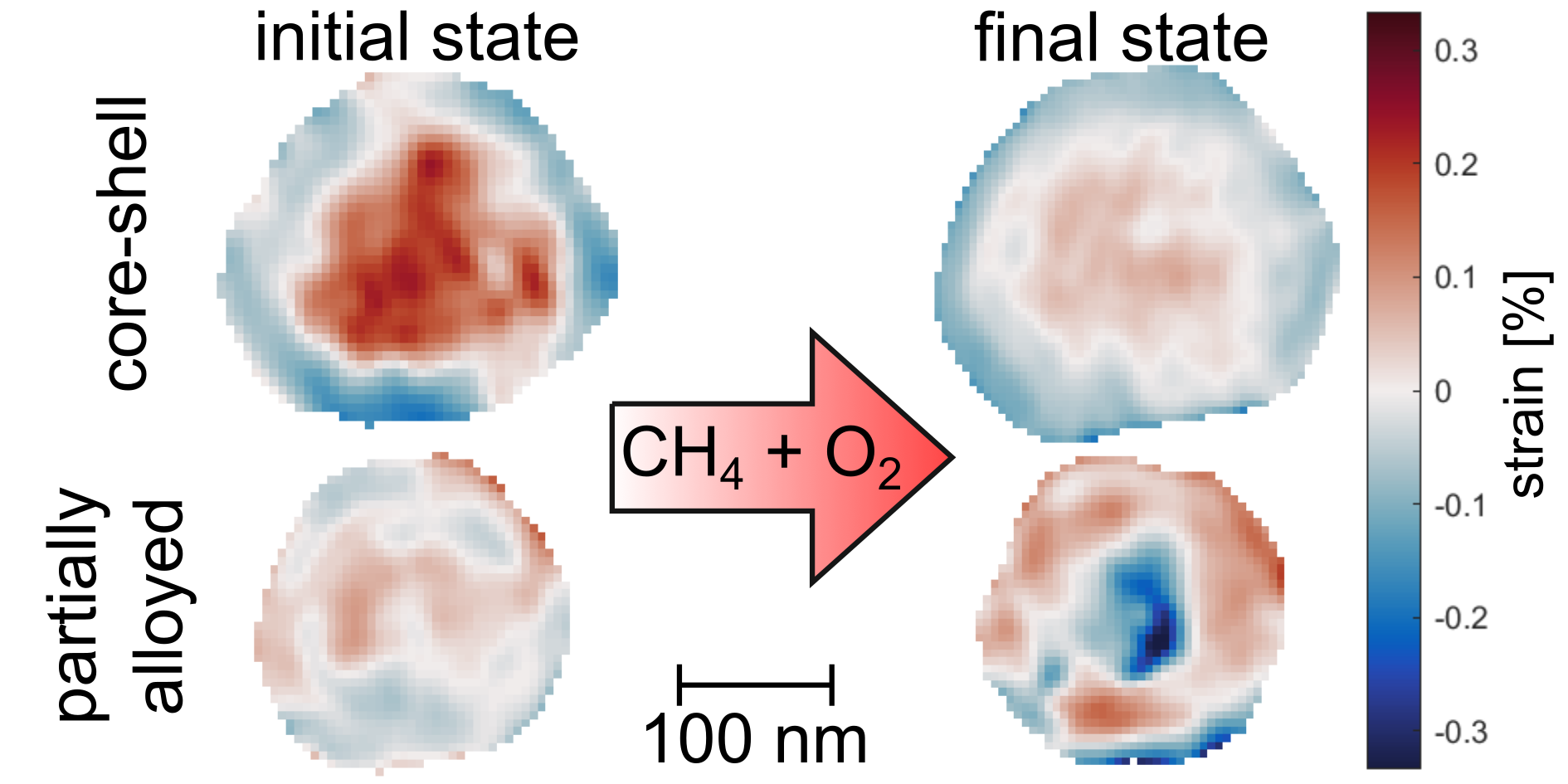
3D view of the initial state of both investigated nanoparticles. The planes indicate the plane of the cuts shown in the figure below. (Credit: Lydia Bachmann, DESY)


Methane, a potent greenhouse gas with a global warming potential 30 times higher than CO2, poses both environmental challenges and energy opportunities. Catalysts that efficiently convert methane CH4 into less harmful substances are therefore of crucial importance. However, their performance is intricately linked to their atomic structure and surface composition. Understanding how these nanoparticles evolve during operation could pave the way for the development of more active and durable catalysts.
In their study a research team from DESY, University of Hamburg (UHH) and the Karlsruhe Institute of Technology (KIT) focused on two types of platinum-palladium (PtPd) nanoparticles with different initial architectures: one with a core-shell structure and one partially alloyed. Core-shell nanoparticles are promising candidates for new catalysts as they result in highly strained structures which are known to improve catalytic activity. Both sample types were prepared by combining electron-beam lithography at the Center for Hybrid Nanostructures (CHyN) at the UHH with electron beam evaporation at the DESY NanoLab. Using in situ Bragg Coherent X-ray Diffraction (BCDI) at the PETRA III beamline P10, it was investigated how temperature and reaction atmospheres influence segregation and mixing at nanometre scales.
In contrast to the initially partially alloyed nanoparticle, the core-shell nanoparticle a facet-dependent segregation of Pt to the closely packed {111} surfaces was observed. This result highlights potential pathways to tailor nanoparticle surface compositions for bifunctional catalysis.
Whereas, upon increasing the temperatures, the Pd and Pt in the initial core-shell nanoparticle started to mix. When the temperature was increased to 680°C, the partially alloyed sample exhibited an even more extreme behaviour, as it formed a Pd-rich core with a Pt shell. Since Pd and its oxide is the most active phase for CH4 oxidation, these findings indicate that the operation temperature should stay below 680°C.
As this study shows, the systematic investigation of promising core-shell nanoparticles and their catalytic activity provides valuable insights for the design of advanced catalysts.
Reference:
L.J. Bachmann, J. Dwivedi, D. Lapkin, B. Wang, J.-C. Schober, G.N. Hinsley, S. Bernart, K. Hoon Ngoi, R. Rysov, A. Dangwal Pandey, T.F. Keller, I. A. Vartanyants and A. Stierle, In situ X-ray imaging of segregation and mixing in PtPd core–shell nanoparticles under methane oxidation conditions, Nanoscale (2026), DOI: 10.1039/D5NR05321H
