


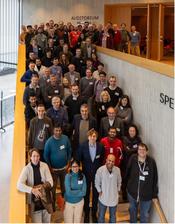


Around 80 scientists from international expert groups discussed the latest theoretical developments and their experimental application to X-ray lasers in the workshop “Theory meets XFELs”. (Credit: EuXFEL)
Around 80 scientists discussed the latest theoretical developments and their experimental application to X-ray lasers at the European XFEL and DESY during the workshop “Theory meets XFELs” from 26 to 28 November 2025.
X-ray Free-Electron Lasers (XFELs) offer state-of-the-art capabilities for experimental research with X-rays. “Modern theory and simulations play an essential role – not only in explaining experimental observations but also in generating new ideas for designing future experiments,” says Serguei Molodtsov, Scientific Director of the European XFEL.
The aim of the workshop series Theory meets XFELs, jointly coorganized by EuXFEL, University of Hamburg (UHH) and DESY Photon Science, was to foster collaborations between theorists and experimentalists engaged in research with XFELs. Topics ranging from experiments under extreme conditions to attosecond physics were covered.
“This year's workshop was dedicated to recent theoretical developments in the fields of extreme states of matter, strong-field phenomena, ultrafast spin, electron, and structural dynamics, and is complemented by excellent examples of experimental applications of XFELs in these fields,” says DESY scientist Beata Ziaja-Motyka, Group Leader at the Center for Free-Electron Laser Science (CFEL).
